
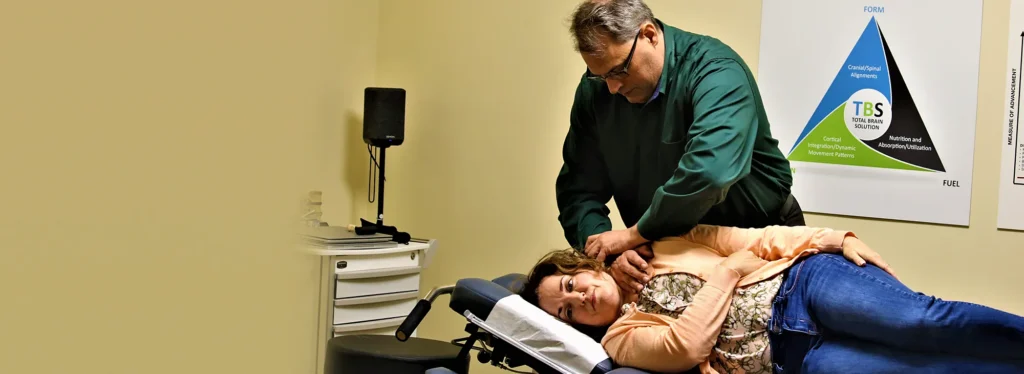
Hurt on the job? Care that helps you get back to work.
Work injuries such as lifting strains and repetitive-motion aches are addressed with hands-on manual therapy and targeted exercise to help relieve pain and move more comfortably again.1
At a glance
Common with
Lifting, repetitive motion, and long hours on your feet
Our approach
Gentle, low-force care with clear documentation
Claims
L&I may cover care for accepted claims — coverage depends on your claim
The basics
What is a work injury?
Common on-the-job injuries include strains, sprains, and irritation of the muscles, joints, and nerves — whether they happen in a single heavy lift or build up from repeated motion over time.2
Some job injuries happen in a moment — a box that was heavier than it looked, a slip, an awkward reach. Others build slowly, as repeated lifting, bending, or standing wears on the same tissues until they finally complain. Either way, the goal is the same: instead of only quieting the ache, we look at what’s actually straining the area — how you’re moving, loading, and holding your body at work — so we can address what’s driving it and help you return to your duties more comfortably.1
The signs
What a work injury can feel like.
- Low-back or neck pain that flares after lifting or bending
- Aching, tight muscles that get worse across a shift
- Sharp or pulling pain when you twist, reach, or carry
- Numbness, tingling, or weakness in the hands or arms
- Stiffness that lingers into the next morning or your day off
- Pain that returns each time you go back to the same task
Everyone’s work and body are different, so these signs vary from person to person. If pain keeps coming back with a task, it’s worth having it looked at before it settles in.
Where it starts
What’s actually causing it.
Heavy & awkward lifting
A single heavy load, or lifting from a twisted or off-balance position, can strain the low back in a moment — and awkward or overhead lifts can load the neck too.3
Repetitive motion & overuse
The same reach, grip, or twist repeated all day wears on the same tissues, so pain builds gradually rather than all at once.4
Sustained posture & standing
Long hours held in one position — hunched at a station or standing on hard floors — keeps muscles and joints loaded without a break.5
Our approach
How we care for work injuries.
A clear path from your first visit toward moving comfortably at work again — with the documentation your claim may need along the way.
01
Evaluate & document
We examine how you’re moving, find where the strain is coming from, and document your care clearly from the start so it supports your claim.
02
Gentle, low-force care
Gentle, low-force adjustments and cold laser are low-risk approaches that may help ease pain and improve motion comfortably6 — no aggressive twisting on an already sore body.
03
Movement, ergonomics & prevention
As you improve, we work on how you lift, move, and set up your station — so the same task is less likely to put you right back where you started.7
Work injuries, specifically
Questions about on-the-job injuries
Will L&I cover my chiropractic care?
Work injuries in Washington are often handled through L&I (Labor & Industries), and chiropractic care may be covered when a claim is accepted. Coverage depends on your specific claim and its status, so the best step is to open a claim and let us document your care from the start. We’re happy to talk it through at your consultation.
Can I choose my own chiropractor for a work injury?
In most cases you’re able to choose the provider you see for a work-related injury.8 We’ll answer your questions honestly, document everything clearly, and coordinate care so the focus stays on getting you comfortable and back to your duties.
What if my injury built up over time instead of one accident?
Plenty of work injuries aren’t a single event — they develop from months of repeated lifting, gripping, or standing. Those cumulative, over-time injuries are just as real, and we treat them the same careful way: find what’s straining the tissue, calm it down, and change the pattern that caused it.2
Do I need a referral to be seen?
No referral is needed to book with us. Depending on your claim and employer, some paperwork may be involved, and we’re glad to help you sort out what’s required so you can get started without the runaround.
Is the care gentle enough if I’m already in pain?
Yes. Dr. Marrone uses gentle, low-force technique designed to restore motion comfortably — a good fit when you’re sore from an injury and wary of forceful adjusting.9 We meet your body where it is and build from there.
Related to work injuries
Back & neck pain
The everyday aches, plus facet syndrome and chronic tension.
Carpal tunnel & shoulders
Arm, wrist, and shoulder pain, from the extremities in.
Auto & whiplash injury
Car-accident care, documented and coordinated for your claim.
Hurt at work? Let’s get you moving comfortably again.
Book a free consultation — we’ll look at what’s causing the pain and help you understand your options, claim and all.
References
- National Institute for Health and Care Excellence (NICE). Low back pain and sciatica in over 16s: assessment and management. NICE guideline [NG59]. Recommendation 1.2 (Non-invasive treatments). Updated 2020. View source ↗
- Occupational Safety and Health Administration (OSHA), U.S. Department of Labor — Ergonomics View source ↗
- Lifting and bending the right way. MedlinePlus Medical Encyclopedia (patient instructions), U.S. National Library of Medicine / National Institutes of Health. View source ↗
- Repetitive strain injury (RSI) View source ↗
- OSHA Computer Workstations eTool — Good Working Positions View source ↗
- Chow RT, Johnson MI, Lopes-Martins RA, Bjordal JM. Efficacy of low-level laser therapy in the management of neck pain: a systematic review and meta-analysis of randomised placebo or active-treatment controlled trials. Lancet. 2009 Dec 5;374(9705):1897-1908. PMID: 19913903. View source ↗
- Russo F, Papalia GF, Vadalà G, Fontana L, Iavicoli S, Papalia R, Denaro V. The Effects of Workplace Interventions on Low Back Pain in Workers: A Systematic Review and Meta-Analysis. Int J Environ Res Public Health. 2021;18(23):12614. doi:10.3390/ijerph182312614. View source ↗
- Choosing a Doctor and Medical Treatment for Work Injuries View source ↗
- National Center for Complementary and Integrative Health. “Spinal Manipulation: What You Need To Know.” National Institutes of Health, U.S. Department of Health and Human Services. https://www.nccih.nih.gov/health/spinal-manipulation-what-you-need-to-know (accessed July 2026). View source ↗