
Meet your chiropractor
He came to chiropractic as a patient.
Dr. Andy Marrone found chiropractic on the receiving end of it — and it changed the direction of his life. Today he brings that same gentle, root-cause care to families, athletes, and injury recovery across the Snohomish valley.

His story
It started with his own back.
In his undergraduate years, Dr. Marrone was sidelined by debilitating low-back pain. The person who finally got him out of it wasn’t a prescription — it was his long-time karate instructor, a chiropractor who would go on to become his mentor. Instead of just quieting the pain, the care focused on how his spine was moving and functioning — and for the first time, the problem eased and let go.1
That experience redirected his whole path. Changing careers meant pushing back against real resistance — including from his own father, a medical doctor who didn’t believe in chiropractic. He went anyway, and earned his Doctor of Chiropractic, determined to give other people the kind of turnaround he’d lived himself.
Chiropractic isn’t just about chasing pain. When your spine moves better and hurts less, it’s easier to get back to the active, energetic life you love2 — that’s what keeps me doing this work.
Since then he’s kept learning — enzyme nutrition, functional digestive testing, how muscles and joints move, how the nervous system carries pain, and the biomechanics of the spine — because structure and chemistry depend on each other, and trouble in one often shows up in the other.3
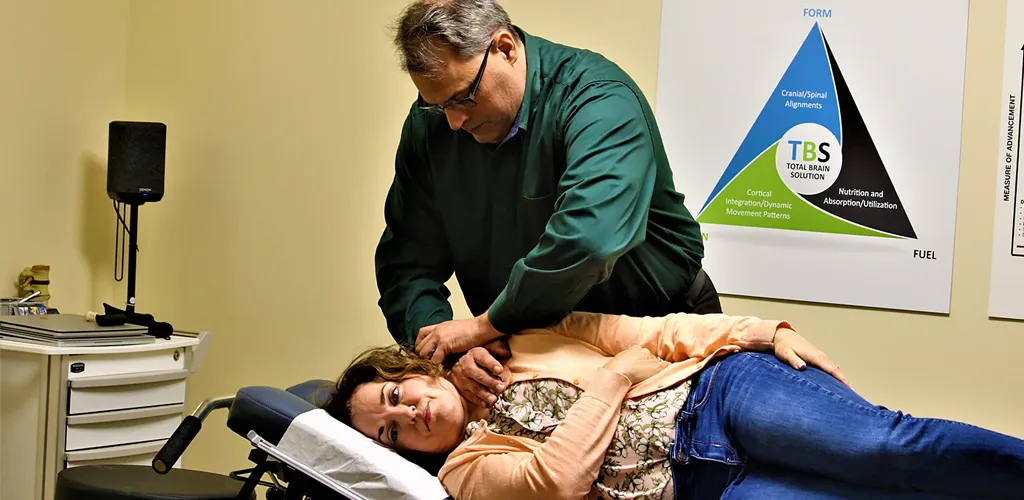
Low-force, hands-on care in the treatment room at Snohomish Chiropractic & Nutrition.
How he works
Three things you can count on.
Gentle, low-force care
Adjustments meant to restore motion comfortably — no aggressive twisting or forceful cracking. Effective for athletes, and gentle enough for children, seniors, and anyone nervous about traditional adjusting.
Treat the cause, not the symptom
The ache is a signal, not the whole story. Dr. Marrone looks for what’s actually driving it and pairs hands-on care with active, self-management strategies — the approach most likely to give relief that lasts, rather than just easing the ache for a while.4
Structure and nutrition, together
He pairs chiropractic care with enzyme nutrition because how you move and how you’re nourished are connected — good nutrition helps supply what tissues need to repair, and staying mobile supports that too. Looking after both is how he supports your body’s own healing.5
Who he helps
Care for every stage of life.
Families
Gentle, low-force care that fits kids, parents, and grandparents alike — the whole household under one roof.
Athletes
Care focused on how your body moves and feels — supporting your training, recovery, and return to the activities you love.6
Injury recovery
A steady path back from the strains and soreness of auto, work, and everyday injuries7 — care documented and coordinated when you need it.
Whole-person nutrition
Enzyme nutrition and functional digestive testing for the fatigue, digestion, and energy issues behind how you feel.8
Good to know
Questions people ask about Dr. Marrone
Is low-force adjusting as effective?
Yes. Low-force technique is designed to restore motion comfortably rather than by force — effective enough for athletes and gentle enough for children, seniors, and anyone nervous about traditional adjusting. You get the benefit without the aggressive twisting.
Do you treat children?
Absolutely. Families are a core part of the practice, and the gentle, low-force approach — rather than forceful adult-style adjusting — is generally well tolerated by kids9. Care is always tailored to the person in the room.
Do I have to change my diet to see you?
No. Enzyme nutrition is available if you want to dig into root causes behind fatigue, digestion, or energy — but it’s an option, not a requirement. Plenty of patients come in purely for chiropractic care.
Come meet Dr. Marrone.
Sit down for a free consultation and get honest answers about whether we can help — no pressure, no obligation. Serving Snohomish, Monroe, Lake Stevens, and Everett.
References
- National Center for Complementary and Integrative Health (NCCIH), NIH. “4 Things To Know About Spinal Manipulation for Low-Back Pain.” nccih.nih.gov (accessed July 2026). View source ↗
- Cote P, Hartvigsen J, Axen I, et al. The global summit on the efficacy and effectiveness of spinal manipulative therapy for the prevention and treatment of non-musculoskeletal disorders: a systematic review of the literature. Chiropractic & Manual Therapies. 2021;29(1):8. View source ↗
- Brotto M, Bonewald L. Interactions between Muscle and Bone—Where Physics Meets Biology. Biomolecules. 2015;5(4):2854-2883 (PMC7175139). View source ↗
- Long-term effectiveness of non-surgical interventions for chronic low back pain: a systematic review and meta-analysis. The Lancet Rheumatology. 2025. View source ↗
- Dragan S, et al. Role of Nutrition in the Management of Patients with Chronic Musculoskeletal Pain. (PMC11214565). Nutrients-adjacent peer-reviewed review, 2024. View source ↗
- Corso M, Cancelliere C, Mior S, Kumar V, Smith A, Côté P. The effects of spinal manipulation on performance-related outcomes in healthy asymptomatic adult population: a systematic review of best evidence. Chiropractic & Manual Therapies. 2019;27:25. View source ↗
- Gevers-Montoro C, Provencher B, Descarreaux M, Ortega de Mues A, Piché M. Clinical Effectiveness and Efficacy of Chiropractic Spinal Manipulation for Spine Pain. Front Pain Res (Lausanne). 2021;2:765921. doi:10.3389/fpain.2021.765921. View source ↗
- Schwarcz J. No Tolerance for IgG Food Intolerance Tests. McGill University Office for Science and Society, Montreal. Accessed 2026. View source ↗
- Misra SM, Jaber O, Long C. Chiropractic Care in Children: A Review of Evidence and Safety. Clinical Pediatrics. 2025. doi:10.1177/00099228241305202. Available at: https://pmc.ncbi.nlm.nih.gov/articles/PMC12138143/ View source ↗