
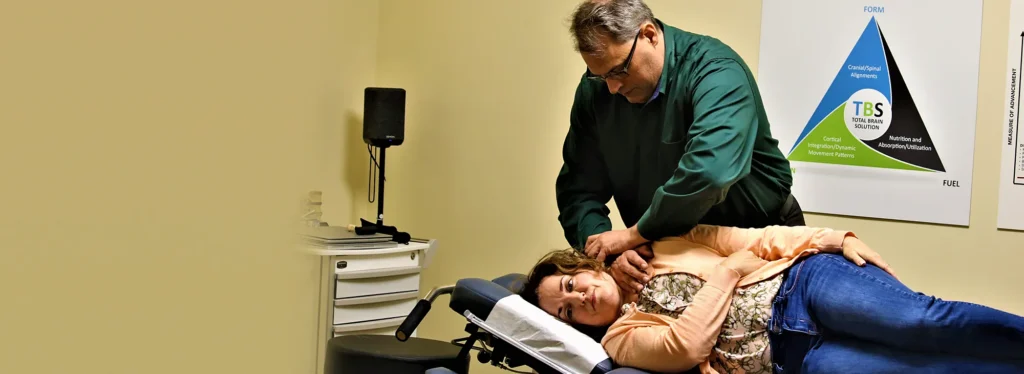
Calm the nerve at its source, not just the leg.
That deep, radiating pain down your leg usually starts in your low back1. We look for what may be irritating the nerve and use gentle, hands-on care and movement guidance to help ease the pain and support your recovery2.
At a glance
What it feels like
A sharp, burning, or shooting pain that travels from the low back into the buttock and down one leg.3
Common causes
Most often a bulging or herniated disc pressing on the sciatic nerve; less commonly a tight piriformis muscle or a vertebra that has shifted out of position.1
The good news
Most sciatica improves over time with gentle, non-surgical care — staying active, targeted exercises, and hands-on therapies.3
The basics
What is sciatica?
The sciatic nerve is the body’s largest nerve, running from the low back through the buttock and down the leg. Sciatica isn’t a disease of its own; it’s a symptom signaling that something is pressing on or irritating that nerve.4
Because sciatica is a symptom, chasing the leg pain alone rarely settles it for good. We take time to find where the nerve is actually being pinched — a disc, a tight muscle, or a joint that’s out of line — and work on that source with gentle, low-force adjustments and cold laser that may help ease the leg pain and discomfort many people feel with sciatica2. Results vary from person to person.
The signs
How sciatica tends to show up.
- Pain that flares when you sit for a while, bend, cough, or sneeze
- Weakness or a heavy, tired feeling in the affected leg
- Symptoms usually on just one side, easing when you change position
If you notice sudden weakness in both legs, or any loss of bladder or bowel control, that’s an emergency — seek urgent care right away.5 For the everyday sciatica that lingers and wears you down, we’re glad to help you get to the bottom of it.
Where it starts
What’s actually causing it.
Herniated or bulging disc
When the cushion between two vertebrae bulges or slips out of place, it can press on the sciatic nerve and send pain down the leg. It’s one of the most common sources we see.1
Piriformis tension
The sciatic nerve runs right beneath the piriformis, a small muscle deep in the buttock. When that muscle tightens or spasms, it can squeeze the nerve and mimic disc-related sciatica.6
Spinal misalignment
When low-back and pelvic joints move poorly, nearby tissue and nerves can become irritated. Gentle chiropractic care aims to restore normal joint motion and ease that irritation — an approach clinical guidelines support as part of care for low back pain.7
Our approach
How we help you find relief.
No forceful twisting and no rushing. We work in three unhurried steps — find the source, ease the pressure, and help keep it from returning.
01
Find the source
We start with a careful exam and your history to pinpoint where the nerve is really being irritated — disc, muscle, or joint — so our care can focus on that mechanical source and restoring movement, not just the leg pain1.
02
Relieve the pressure
Gentle, low-force adjustments may help improve low-back mobility and ease discomfort, and we may pair them with cold laser and nutritional support for digestion and general wellness as part of a comfort-focused care plan.8
03
Keep it from returning
As you improve, we share simple movement and posture habits to support your low back — so the relief holds and sciatica is less likely to flare down the road9.
Sciatica & disc pain, specifically
Questions people ask about sciatica
Can chiropractic care actually help my sciatica?
For many people, yes. Most sciatica comes from a nerve being compressed in the lower back, often by a herniated (“slipped”) disc. Gentle chiropractic care and other manual therapy may help ease the pain for some people, and many cases of sciatica improve over a few weeks to months.10
Is the adjustment going to hurt if I’m already in pain?
Dr. Marrone uses gentle, low-force technique — no aggressive cracking or twisting. It’s a gentle, low-force alternative to forceful manipulation, avoiding the hard thrust and joint “cracking” of high-velocity adjustments — often a well-tolerated fit for seniors, patients with bone-density concerns, and nervous first-timers alike.11
How soon might I feel better?
Everyone is different, and it depends on what’s causing your sciatica and how long it’s been going on. Some people feel easier within the first few visits; others need a bit more time.3 After your exam we’ll give you an honest picture of what to expect.
Do I need surgery or a referral first?
Most sciatica improves without surgery, and you don’t need a referral to be seen — you can book directly. Conservative, non-surgical care is usually the sensible first step12, and if we ever felt you needed more, we’d tell you honestly.
What can I do at home to ease a flare-up?
Gentle movement and short walks usually beat long stretches of sitting or bed rest, which can stiffen things up. Once we’ve seen you, we’ll suggest simple positions and habits that fit your situation so you’re not guessing between visits.
Related to Sciatica & disc pain
Back & neck pain
The everyday aches, plus facet syndrome and chronic low-back tension.
Work injuries
On-the-job strains and repetitive-use low-back pain — back to full duty.
Auto & whiplash injury
Car-accident care, documented and coordinated for your claim.
Ready to get to the root of your sciatica?
Let’s find what’s pressing on the nerve and ease it gently — no pressure, no obligation, just an honest look at whether we can help.
References
- Davis D, Maini K, Taqi M, Vasudevan A. Sciatica. In: StatPearls [Internet]. Treasure Island (FL): StatPearls Publishing. View source ↗
- Zhu Z, Schouten T, Strijkers R, Koes B, Gerger H, Chiarotto A. Effectiveness of non-surgical interventions for patients with chronic sciatica: A systematic review with network meta-analysis. J Pain. 2025. View source ↗
- Sciatica — NHS (National Health Service, UK) View source ↗
- Sciatica — Cleveland Clinic (health library) View source ↗
- American Association of Neurological Surgeons (AANS) — Cauda Equina Syndrome (patient conditions & treatments) View source ↗
- Hicks BL, Lam JC, Varacallo MA. Piriformis Syndrome. In: StatPearls [Internet]. Treasure Island (FL): StatPearls Publishing. View source ↗
- National Institute for Health and Care Excellence (NICE). Low back pain and sciatica in over 16s: assessment and management. NICE guideline [NG59]. Recommendation 1.2 (Non-invasive treatments). Updated 2020. View source ↗
- Rubinstein SM, de Zoete A, van Middelkoop M, Assendelft WJJ, de Boer MR, van Tulder MW. Benefits and harms of spinal manipulative therapy for the treatment of chronic low back pain: systematic review and meta-analysis of randomised controlled trials. BMJ. 2019;364:l689. View source ↗
- Steffens D, Maher CG, Pereira LSM, Stevens ML, Oliveira VC, Chapple M, Teixeira-Salmela LF, Hancock MJ. Prevention of Low Back Pain: A Systematic Review and Meta-analysis. JAMA Intern Med. 2016;176(2):199-208. View source ↗
- de Zoete A, Innocenti T, Petrozzi MJ, van Middelkoop M, Assendelft WJJ, de Boer MR, van Tulder MW, Rubinstein SM. Spinal manipulative therapy for adults with chronic low back pain. Cochrane Database of Systematic Reviews. View source ↗
- Huggins T, Boras AL, Gleberzon BJ, Popescu M, Bahry LA. Clinical effectiveness of the activator adjusting instrument in the management of musculoskeletal disorders: a systematic review of the literature. J Can Chiropr Assoc. 2012 Mar;56(1):49-57. PMID: 22457541; PMCID: PMC3280118. View source ↗
- OrthoInfo — American Academy of Orthopaedic Surgeons (AAOS), “Sciatica” View source ↗