
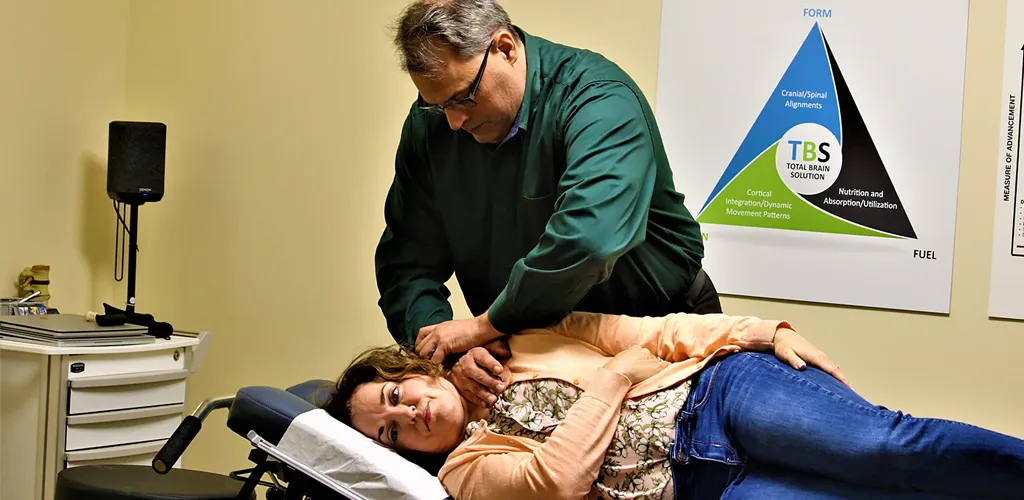
Wrist and hand pain? Sometimes it starts higher up.
Numb fingers and a weak grip feel like a wrist problem — but the nerves that feed your hand run all the way up through the forearm, shoulder, and neck1. We look at the whole chain, not just where it hurts.
At a glance
Feels like
Numbness, tingling, and a grip that gives out
Often from
Repetitive hand work plus tension up the arm and neck
Our approach
Gentle, low-force care along the whole chain — plus ergonomics
The basics
What is carpal tunnel & extremity strain?
Carpal tunnel syndrome is compression of the median nerve where it passes through the carpal tunnel at the wrist. In some people, similar hand and wrist symptoms can also be influenced by irritation of the same nerve elsewhere along its path — in the forearm or from the neck2 — which is why a careful look at the whole chain can help.
The nerves that give your hand feeling and strength start at the neck, thread past the shoulder, and travel down the arm before they ever reach the wrist. Irritate that pathway anywhere along the way — tight forearm muscles, a rounded shoulder, tension in the neck — and your hand can feel it. That’s why treating only the wrist so often falls short.3 We look at how the whole arm and neck move together, find where the nerve is actually getting squeezed, and work to take the pressure off at the source.
The signs
The signs it may be more than your wrist.
- Numbness or tingling in the thumb, index, and middle fingers
- Symptoms that flare at night and wake you up
- A weak grip — dropping things or trouble with jar lids and buttons
- An ache that runs up the forearm, elbow, or into the shoulder
- Symptoms that worsen with typing, gripping, or overhead work
- Tightness in the neck and shoulder on the same side as the hand
Most mild-to-moderate carpal tunnel cases respond well to conservative, non-surgical care — clinical literature reports symptom improvement in roughly 70–90% of such cases.2 But if numbness is constant, the muscle at the base of your thumb is visibly shrinking, or symptoms are steadily getting worse, that can signal a more serious nerve problem4 — we’ll tell you honestly and refer you to a medical doctor when that’s the right call.
Where it starts
What’s actually causing it.
Repetitive hand & keyboard work
Repetitive hand and wrist activity — including sustained keyboard and mouse work — can irritate the tendons in the wrist, causing them to swell and narrow the carpal tunnel, which raises pressure on the median nerve.5
Compression up the arm & neck
Hand and finger symptoms don’t always begin at the wrist. The median nerve — and the neck nerve roots that feed it — can be irritated at several points along its path: in the forearm (for example, where the nerve passes between the two heads of the pronator teres muscle), around the shoulder, or at the neck, even when the wrist itself looks fine.3
Posture & overhead strain
Rounded shoulders, forward head posture, and repeated overhead reaching can alter how the arm is loaded and add tension or compression along the nerve pathway that runs from the neck into the arm, which may aggravate and prolong shoulder, arm, and hand or wrist symptoms.6
Our approach
How we work to take the pressure off.
Gentle, low-force manual therapy and joint mobilization may help ease hand symptoms such as pain and reduced grip or function, and are often used alongside other conservative measures as part of a broader care plan.7
01
Find where the nerve is compressed
We check the whole chain — wrist, forearm, elbow, shoulder, and neck — to pinpoint where the median nerve is actually getting squeezed, instead of assuming it’s the wrist.
02
Gentle care, cold laser & soft tissue
Gentle manual therapy and soft-tissue work — sometimes combined with cold laser — may help calm irritated muscle and tendon and ease tension around nearby nerves, which can reduce pain and improve function.8 Evidence for these conservative approaches is still limited, and results vary from person to person.
03
Ergonomics & keeping it away
Ergonomic adjustments, gentle stretches, and better daily habits — like taking regular breaks and easing up on repetitive hand movements — can reduce strain on the wrist and may help lower the chance that symptoms return after they improve.9
Carpal tunnel & shoulders, specifically
Questions people ask about wrist and shoulder pain
Can chiropractic help carpal tunnel without surgery?
For many people, conservative care is a reasonable first step before considering surgery. When carpal tunnel syndrome is caught early or is mild-to-moderate, symptoms can often be relieved without surgery. Splinting, activity and ergonomic changes, and gentle soft-tissue and nerve-gliding work aim to reduce irritation of the median nerve, and many people find these conservative measures helpful.4 We can’t promise a cure or that you’ll avoid surgery. If yours doesn’t, or if it looks more serious, we’ll tell you and help you find the right next step.
Why does my shoulder hurt too?
Because the nerves feeding your hand start up at the neck and pass right through the shoulder on their way down the arm. When that pathway is irritated — or when you’ve been compensating for a sore wrist for a while — the shoulder and neck often get pulled into it. It’s very common to have wrist, forearm, and shoulder symptoms at the same time10, which is exactly why we look at the whole chain rather than just the spot that hurts most.
Do I need a referral or a diagnosis first?
No referral needed — you can book directly. At your visit we’ll assess how your wrist, arm, shoulder, and neck are moving to understand what’s driving your symptoms. If we think you’d benefit from imaging or a medical evaluation, we’ll say so and coordinate from there.
How long until I notice a difference?
It depends on how long symptoms have been building and what’s causing them. Response times vary from person to person. Recent, acute complaints often ease within the first few weeks of care, while longer-standing (chronic) problems tend to improve more gradually and can take more time.11 We’ll give you an honest sense of what to expect after we’ve assessed you — no cookie-cutter promises.
Is this related to a work injury?
Often, yes. Repetitive or forceful hand and wrist work — along with sustained awkward wrist postures and vibrating tools — is a well-recognized contributor to carpal tunnel syndrome and other upper-extremity symptoms. Heavy computer/keyboard use and overhead work may also aggravate symptoms for some people, though the evidence is more mixed.2 If yours is work-related, we treat repetitive-use injuries regularly and document your care to support a claim when that applies.
Related to Carpal tunnel & shoulders
Back & neck pain
Chronic tension and trigger points in the neck, shoulder, and upper-back muscles can refer pain into the arm and hand, and irritated cervical facet joints often add to neck and shoulder pain.
Headaches & migraines
Tension headaches and migraines often linked to neck and shoulder tension.
Work injuries
On-the-job strains and repetitive-use pain — back to full duty.
Numb hands and a sore shoulder? Let’s find the source.
Book a free consultation and we’ll look at the whole chain — wrist, arm, shoulder, and neck — and give you an honest answer about whether we can help.
References
- Bayot ML, Nassereddin A, Varacallo MA. Anatomy, Shoulder and Upper Limb, Brachial Plexus. StatPearls [Internet]. Treasure Island (FL): StatPearls Publishing. View source ↗
- Sevy JO, Sina RE, Varacallo MA. Carpal Tunnel Syndrome. In: StatPearls [Internet]. Treasure Island (FL): StatPearls Publishing; last updated October 29, 2023. View source ↗
- Murphy KA, Morrisonponce D. Anatomy, Shoulder and Upper Limb, Median Nerve. StatPearls [Internet]. Treasure Island (FL): StatPearls Publishing; updated December 1, 2025. View source ↗
- American Academy of Orthopaedic Surgeons (OrthoInfo) — Carpal Tunnel Syndrome View source ↗
- National Institute of Arthritis and Musculoskeletal and Skin Diseases (NIAMS), NIH — “Carpal Tunnel Syndrome” (Causes / Overview) View source ↗
- Thoracic Outlet Syndrome — OrthoInfo, American Academy of Orthopaedic Surgeons (AAOS) View source ↗
- Sault JD, Jayaseelan DJ, Mischke JJ, Post AA. The Utilization of Joint Mobilization As Part of a Comprehensive Program to Manage Carpal Tunnel Syndrome: A Systematic Review. J Manipulative Physiol Ther. 2020 May;43(4):356-370. View source ↗
- Wolny T, et al. Short-term Effects of Neurodynamic Techniques for Treating Carpal Tunnel Syndrome: A Systematic Review With Meta-analysis. J Orthop Sports Phys Ther. 2021. View source ↗
- Carpal Tunnel Syndrome: Diagnosis, Treatment, and Steps to Take View source ↗
- Cervical Radiculopathy (Pinched Nerve) View source ↗
- da C Menezes Costa L, Maher CG, Hancock MJ, McAuley JH, Herbert RD, Costa LO. The prognosis of acute and persistent low-back pain: a meta-analysis. CMAJ. 2012 Aug 7;184(11):E613-24. View source ↗