
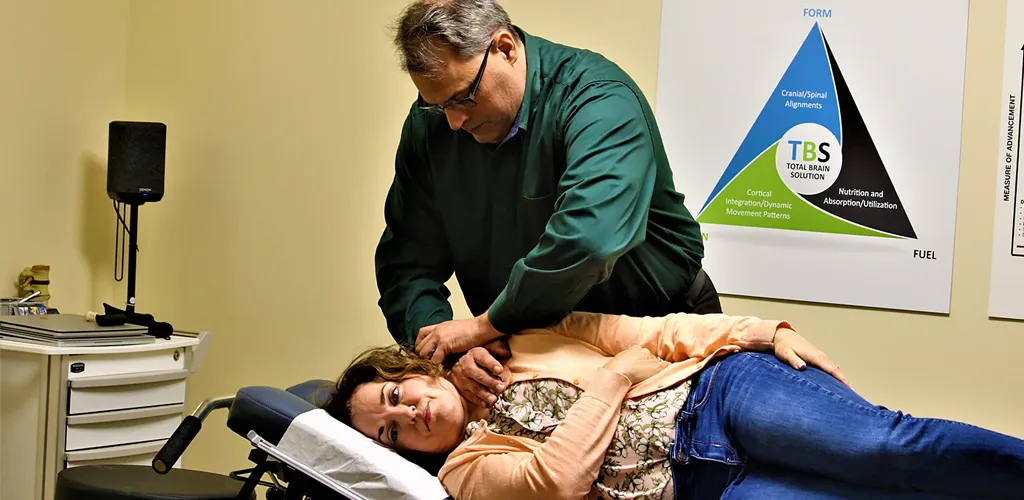
After the crash, help getting back in line.
Even a low-speed collision can leave your neck and back hurting for weeks.1 We evaluate what the impact did, document it carefully, and use gentle, low-force techniques (no forceful cracking required) as part of an active recovery plan — combined with movement and at-home exercises to help you get back to normal activity2.
At a glance
Delayed symptoms
Common — pain often shows up hours or days later, not at the scene1
Coverage
In Washington, care is often covered by PIP, frequently with no referral needed
Best next step
Get evaluated soon after the accident, even if you feel mostly okay
The basics
What is whiplash?
Whiplash is a neck injury caused when the head is suddenly whipped back and forth — most often in a car accident. The rapid motion strains the soft tissues, joints, and ligaments of the neck faster than they can brace for it.1
Right after a crash, adrenaline and shock can mask what your body is feeling, so it’s common to walk away thinking “I feel fine.” Then a day or two later the neck stiffens, headaches set in, or turning to check a mirror suddenly hurts. That delay is normal — inflammation and muscle guarding build over time1. Getting evaluated early matters for two reasons: it means starting gentle movement and active care soon after the injury — rather than resting or keeping the neck in a collar — is associated with better recovery and a lower chance of lingering neck pain and stiffness3, and it puts a clear, dated record of your injury on file from the start — which can matter a great deal if an insurance claim is involved.
The signs
What whiplash tends to feel like.
- Neck stiffness and soreness, often worse the morning after
- Headaches that start at the base of the skull4
- Reduced range of motion — hard to turn or tilt your head
These are common patterns, not a diagnosis. Severe pain, weakness, or symptoms after a serious impact should be evaluated urgently — if anything feels alarming, seek emergency medical care first, then let us help with your recovery.
Where it starts
What’s actually causing it.
Rapid acceleration–deceleration
The impact throws your head back and then forward in a fraction of a second — faster than your neck muscles can catch it. Even a low-speed bump can generate enough force to injure6.
Soft-tissue & ligament strain
Muscles and the ligaments that stabilize your neck get overstretched in the whip motion. The result is inflammation, guarding, and the soreness that often builds over the following days.1
Joint restriction
After a whiplash injury, the small joints of the cervical spine (facet joints) are a common source of ongoing neck stiffness and headaches that can persist even after the initial soreness fades.7
Our approach
Gentle care, from the first visit forward.
We take auto injuries one careful step at a time — understand what happened, calm things down, then rebuild the motion so you’re not left with lingering stiffness.
01
Evaluate & document
We look at how your neck and back are moving, listen to what happened, and record clear, dated notes on your findings — a record that supports both your recovery and any claim.
02
Gentle low-force + cold laser
Gentle, low-force adjustments aim to improve joint motion and function, and cold laser (low-level laser) therapy may help reduce pain in irritated soft tissue.8 Comfortable enough for a freshly injured neck.
03
Restore & prevent
As things settle, active rehabilitation — range-of-motion and strengthening exercises and staying active — can help restore neck mobility and strength and support recovery. Most people improve within a few months, though recovery varies from person to person.9
Auto & whiplash injury, specifically
Questions after a car accident
Will my care be covered after a car accident?
In Washington, auto-injury care is commonly covered by PIP — personal injury protection — which is part of most auto policies and typically pays regardless of who was at fault. Every policy is different, so we’ll help you understand your coverage and handle the paperwork on our end. This is general information, not legal or insurance advice; your insurer or attorney can confirm the specifics of your policy.
How soon after the accident should I come in?
As soon as you reasonably can — ideally within the first few days, even if you feel mostly fine. Whiplash symptoms often show up later, and getting evaluated early lets us start gentle care before things tighten up and creates a clear, dated record of your injury from the start.
Do I need a referral to be seen for an auto injury?
Generally no. Under Washington PIP, care is often available with no referral needed — you can usually book directly with us. If your particular plan or situation requires something specific, we’ll let you know when you call.
I already saw a doctor at the ER — can I still come to you?
Yes. Emergency care rules out anything serious right after the crash; ongoing chiropractic care is a different piece of the recovery. Many patients come to us after an ER or urgent-care visit to work on the stiffness, restricted motion, and headaches that follow a whiplash injury.10
Is the adjustment safe if my neck is already hurt?
Dr. Marrone favors gentle, low-force techniques for a recently injured neck. After we screen for any serious injury, this well-tolerated approach — used alongside gentle exercise and other supportive care — may help ease pain and restore comfortable movement.11 We always start by evaluating what you can comfortably tolerate and adjust the plan to you. We can’t promise a specific outcome, but the whole approach is built around comfort and steady progress.
Related to Auto & whiplash injury
Back & neck pain
The everyday aches, plus facet syndrome and chronic tension.
Headaches & migraines
Tension headaches and migraines often linked to neck tension.
Work injuries
On-the-job strains and repetitive-use pain — back to full duty.
Been in an accident? Let’s take a look.
Book a free consultation and we’ll walk you through your recovery and your coverage — no pressure, no obligation.
References
- Cleveland Clinic. “Whiplash: Symptoms, Causes, Diagnosis & Treatment.” Cleveland Clinic. https://my.clevelandclinic.org/health/diseases/11982-whiplash (accessed July 17, 2026). View source ↗
- Côté P, Wong JJ, Sutton D, et al. Management of neck pain and associated disorders: A clinical practice guideline from the Ontario Protocol for Traffic Injury Management (OPTIMa) Collaboration. Eur Spine J. 2016;25(7):2000-2022. https://pubmed.ncbi.nlm.nih.gov/26984876/ View source ↗
- Rosenfeld M, Seferiadis A, Carlsson J, Gunnarsson R. Active intervention in patients with whiplash-associated disorders improves long-term prognosis: a randomized controlled clinical trial. Spine (Phila Pa 1976). 2003 Nov 15;28(22):2491-8. View source ↗
- Al Khalili Y, Ly NK, Murphy PB. Cervicogenic Headache. [Updated 2022 Oct 3]. In: StatPearls [Internet]. Treasure Island (FL): StatPearls Publishing; 2026 Jan-. Available from: https://www.ncbi.nlm.nih.gov/books/NBK507862/ View source ↗
- Whiplash — Healthdirect Australia View source ↗
- Brault JR, Wheeler JB, Siegmund GP, Brault EJ. Clinical response of human subjects to rear-end automobile collisions. Arch Phys Med Rehabil. 1998 Jan;79(1):72-80. PMID: 9440422. View source ↗
- Lord SM, Barnsley L, Wallis BJ, Bogduk N. Chronic cervical zygapophysial joint pain after whiplash. A placebo-controlled prevalence study. Spine (Phila Pa 1976). 1996 Aug 1;21(15):1737-44. View source ↗
- Chow RT, Johnson MI, Lopes-Martins RA, Bjordal JM. Efficacy of low-level laser therapy in the management of neck pain: a systematic review and meta-analysis of randomised placebo or active-treatment controlled trials. Lancet. 2009 Dec 5;374(9705):1897-1908. PMID: 19913903. View source ↗
- Southerst D, Nordin M, Côté P, et al. Is exercise effective for the management of neck pain and associated disorders or whiplash-associated disorders? A systematic review by the Ontario Protocol for Traffic Injury Management (OPTIMa) Collaboration. The Spine Journal. 2016. View source ↗
- Bussieres AE, Stewart G, Al-Zoubi F, et al. The Treatment of Neck Pain-Associated Disorders and Whiplash-Associated Disorders: A Clinical Practice Guideline. J Manipulative Physiol Ther. 2016 Oct;39(8):523-564.e27. PMID: 27836071. doi:10.1016/j.jmpt.2016.08.007 View source ↗
- Bryans R, Decina P, Descarreaux M, et al. Evidence-based guidelines for the chiropractic treatment of adults with neck pain. J Manipulative Physiol Ther. 2014;37(1):42-63. View source ↗