
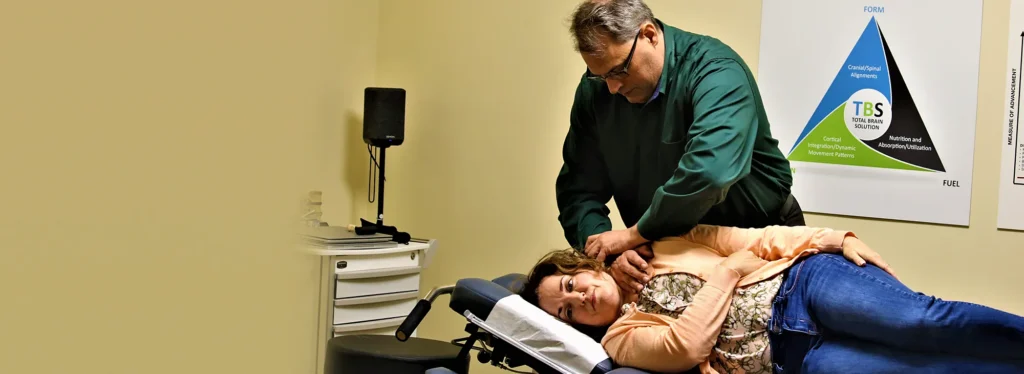
Real relief from headaches often starts with your neck.
Many headaches are closely tied to tight, irritated joints and muscles at the top of your spine — cervicogenic headaches actually start there, and tension headaches are often aggravated by neck and shoulder tension.1 We look there first, and work to calm the source instead of chasing the ache.
At a glance
What it feels like
A tight band around the head, pain that climbs from the base of the skull, or a throbbing, light-sensitive migraine.
Common causes
Irritated joints in the upper neck, muscle tension and desk posture, plus everyday triggers like stress, sleep, and diet.2
The good news
When the neck is the driver, gentle care to restore motion and ease tension can make headaches less frequent and less intense.3
The basics
What’s really behind your headaches?
A headache is a symptom, not a diagnosis — and many trace straight back to the neck. When the joints and muscles at the top of the spine are stiff or strained, they can refer pain up into the head, a pattern often called a cervicogenic (neck-related) headache.1
The upper neck and the base of the skull are packed with nerves and muscles that share pathways with the head. Sit hunched over a phone or keyboard all day, sleep in an awkward position, or carry chronic stress in your shoulders, and those upper-neck joints lose their normal motion. The surrounding muscles tighten, the shared nerve pathways get irritated, and the result shows up as head pain.1 That’s why so many people who think they only have “headaches” actually have a neck that’s been quietly asking for attention — and why looking at the spine can change the whole picture.
The signs
Signs your headaches may be coming from your neck.
- Pain that starts at the base of the skull and spreads forward
- A tight, band-like ache or pressure around the head
- Headaches that flare after long hours at a desk, phone, or wheel
- Stiffness or reduced motion when you turn or tilt your head
- Throbbing, light- or sound-sensitive migraines, sometimes with nausea
- Tender, knotted muscles across the neck and shoulders
Recognize a few of these? It’s a strong hint that your neck is part of the story. A consultation lets us check how your upper spine moves and whether calming that area could ease your headaches.
Where it starts
What’s actually causing it.
The neck connection
Loss of normal motion in the upper neck (cervical) joints can irritate nerves shared between the neck and head, referring pain upward. These cervicogenic (neck-related) headaches are a frequently overlooked and commonly misdiagnosed source of head pain.1
Muscle tension & posture
Prolonged screen use often pulls the head forward, which can strain the muscles of the neck and shoulders. Over time this tension may build tight, tender bands (myofascial trigger points) in muscles that attach around the base of the skull — a pattern commonly associated with tension-type headaches.2
Triggers & nutrition
Stress, poor sleep, dehydration, skipped meals, and certain foods can be migraine triggers for some people.4 We can help you keep a simple food-and-symptom diary to spot possible dietary and digestive triggers and support balanced nutrition alongside your chiropractic care.
Our approach
Calming the source, not just the symptom.
Instead of masking the pain, we work to find why your headaches keep coming back — starting with your neck — and build a plan around what we find.
01
Find the pattern
We talk through your history and triggers, then check how your upper neck moves and where muscles are holding tension — so we can tell how much of your headache is coming from the spine.
02
Restore motion, gently
For headaches that originate in the neck (cervicogenic headache), gentle low-force adjustments and soft-tissue techniques — often paired with targeted neck exercises — may help ease tension in the upper-cervical joints and muscles and reduce how often and how intensely these headaches occur.5
03
Keep them away
Simple posture habits, stretches, and — when it fits — attention to nutrition and common dietary triggers can help make relief last, so many people find their headaches show up less often and feel less intense.6
Headaches & migraines, specifically
Questions people ask about headache care
Can chiropractic care really help my headaches?
For neck-related headaches — especially cervicogenic headaches, and often tension-type headaches — gentle chiropractic care that restores neck motion and eases muscle tension may help reduce how often headaches occur and how severe they feel.7 We can’t promise a cure, but the first step is a consultation to see how much of your headache is coming from your spine.
How do I know if my headache is coming from my neck?
Clues include pain that starts at the base of the skull, stiffness when you turn your head, and headaches that flare after long hours at a desk or on your phone. During your visit we check how your upper neck moves and where muscles are tight, which helps us tell how much the spine is involved.
Are the adjustments forceful or painful?
No. Dr. Marrone uses a gentle, low-force technique that applies lighter, more controlled pressure than traditional manual (high-velocity) adjusting. It’s an approach many patients prefer — comfortable enough for children, seniors, and anyone nervous about traditional neck adjusting, while still suitable for active athletes.8
When should a headache be treated as an emergency?
Some headaches need urgent medical attention rather than chiropractic care. Seek emergency or ER care right away if you have a sudden, severe “worst headache of your life,” a headache with fever and a stiff neck, weakness or numbness, trouble speaking, sudden vision loss, or a headache that follows a head injury.9 When in doubt, get checked by a medical provider first — we’ll gladly see you for the neck-related component once serious causes have been ruled out.
Do you look at diet and other migraine triggers too?
Yes. For some people, certain foods can act as migraine triggers — a headache diary and a careful, one-food-at-a-time look at your diet can help you spot them. Paired with chiropractic care, which some early research suggests may help reduce how often migraines occur, this gives us more of your triggers to work with, not just where you feel the pain.10
Related to Headaches & migraines
Back & neck pain
The everyday aches, plus facet syndrome and chronic tension in the neck.
Vertigo & dizziness
Dizziness and balance issues that can relate to upper-neck function.
Auto & whiplash injury
Whiplash care for the neck pain and headaches that follow a crash.11
Tired of living around your headaches?
Let’s find out whether your neck is the missing piece. Book a free consultation — honest answers, no pressure, no obligation.
References
- Al Khalili Y, Ly NK, Murphy PB. Cervicogenic Headache. [Updated 2022 Oct 3]. In: StatPearls [Internet]. Treasure Island (FL): StatPearls Publishing; 2026 Jan-. Available from: https://www.ncbi.nlm.nih.gov/books/NBK507862/ View source ↗
- Tension-Type Headaches. Cleveland Clinic Health Library, article 8257. View source ↗
- Fernandez M, Moore C, Tan J, Lian D, Nguyen J, Bacon A, Christie B, Shen I, Waldie T, Simmonds M, Hebert J. Spinal manipulation for the management of cervicogenic headache: A systematic review and meta-analysis. European Journal of Pain. 2020;24(9):1687-1702. View source ↗
- Gazerani P. Migraine and Diet. Nutrients. 2020;12(6):1658. View source ↗
- Jull G, Trott P, Potter H, Zito G, Niere K, Shirley D, Emberson J, Marschner I, Richardson C. A randomized controlled trial of exercise and manipulative therapy for cervicogenic headache. Spine (Phila Pa 1976). 2002 Sep 1;27(17):1835-1843. View source ↗
- Headaches: What You Need To Know View source ↗
- Bronfort G, Haas M, Evans R, Leininger B, Triano J. Effectiveness of manual therapies: the UK evidence report. Chiropr Osteopat. 2010 Feb 25;18:3. doi:10.1186/1746-1340-18-3 View source ↗
- Huggins T, Boras AL, Gleberzon BJ, Popescu M, Bahry LA. Clinical effectiveness of the activator adjusting instrument in the management of musculoskeletal disorders: a systematic review of the literature. J Can Chiropr Assoc. 2012 Mar;56(1):49-57. View source ↗
- MedlinePlus Medical Encyclopedia: “Headache” (article 003024), U.S. National Library of Medicine / National Institutes of Health View source ↗
- National Center for Complementary and Integrative Health. “Spinal Manipulation: What You Need To Know.” National Institutes of Health, U.S. Department of Health and Human Services. https://www.nccih.nih.gov/health/spinal-manipulation-what-you-need-to-know (accessed July 2026). View source ↗
- Whiplash — NHS (National Health Service, UK) View source ↗