
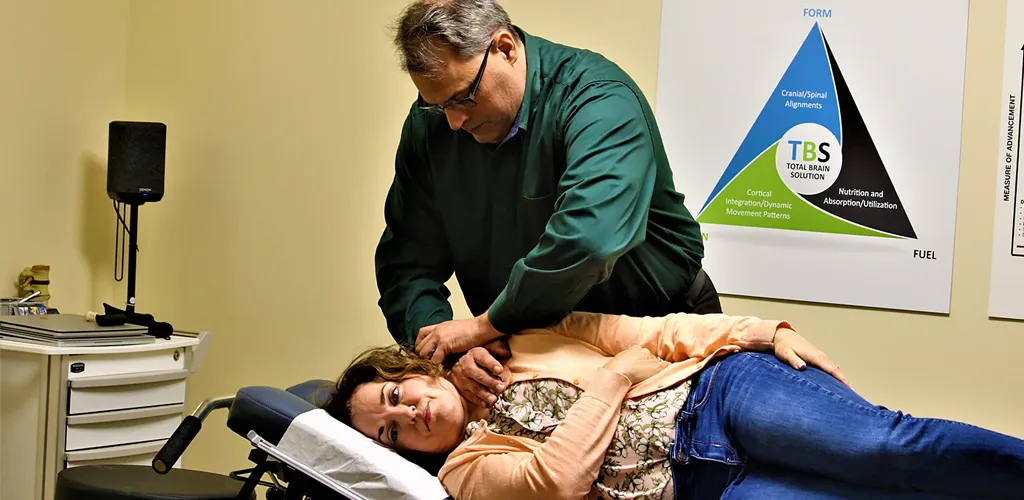
Relief that starts with the real source of your back and neck pain.
Back and neck pain usually isn’t random. For most people no single structural cause can be pinpointed, but everyday factors often contribute — how you move and load your spine, long hours sitting or repeated lifting, and past injuries that still bother you.1 We find that source, ease the pain gently, and help keep it from coming back.
At a glance
What it feels like
Stiffness, aching, or sharp catches in the back or neck — often worse after sitting, sleeping, or a long day.
Common causes
Back and neck pain most often comes from everyday strain and posture, an old injury that never fully settled, or mechanical problems in the joints, discs, and muscles of the spine.2
The good news
Many people with back or neck pain find meaningful relief with gentle, low-force chiropractic care. Research suggests spinal manipulation can modestly reduce pain and improve function, and it tends to work best alongside movement and exercise.3 Results vary from person to person.
The basics
What is back and neck pain?
Back and neck pain is discomfort along the spine and the muscles around it — usually a sign that the joints, muscles, or nerves in your back or neck aren’t moving and working the way they should.2
It can show up as a dull ache that never quite leaves, a stiff neck you can’t turn, or a sudden sharp catch when you bend or twist. Sometimes it comes from one obvious moment — lifting a box, a fender bender, a bad night’s sleep — but just as often it builds quietly over months of sitting, screen time, and small strains that add up. Because the spine houses the nerves that carry pain signals, trouble in one area can radiate into your shoulders, hips, or arms.4 The point of care isn’t just to quiet the ache; it’s to find what’s driving it and help your body move freely again.
The signs
Signs it’s worth getting looked at.
- A dull ache or stiffness in your back or neck that keeps returning.
- Reduced range of motion — trouble turning your head or bending without a catch.
- Pain that flares after sitting, sleeping, or long hours at a desk or wheel.
- Muscle tightness or spasms that seem to come out of nowhere.
- Aching, tingling, or numbness spreading into your shoulders or arms.
- Frequent tension headaches that start at the base of your skull.
If any of these sound familiar — especially pain that lingers past a week or two, or keeps coming back — it’s worth having it looked at before your body adapts around it.
Where it starts
What’s actually causing it.
Everyday strain & posture
Desk work and poor posture, long hours on your phone, and heavy or repetitive lifting can gradually stress the muscles, joints, and ligaments of the spine — and a flare-up is sometimes set off by an ordinary movement like bending or twisting.2
Injury & old trauma
A car accident, a fall, a sports collision, or a work injury can change how the spine moves for a long time afterward. Sometimes pain that seems to appear “for no reason” can relate back to an earlier injury the body never fully recovered from.5
Spinal misalignment
When spinal joints become stiff or restricted, the surrounding muscles often tighten and the area can become sore. Chiropractic adjustment aims to restore normal joint motion, and research shows spinal manipulation can provide modest, short-term relief for mechanical back and neck pain.3
Our approach
How we treat back and neck pain.
We work in a simple order: find the source, relieve the pain gently, then help keep it from returning. No aggressive twisting, no one-size-fits-all plan.
01
Find the source
We start with a thorough look at how your spine moves, where it’s restricted, and what’s feeding the pain — so care targets the cause, not just the sore spot.
02
Relieve it gently
Gentle, low-force adjustments and mobilization may help ease stiff, achy joints and improve movement, while cold laser therapy may help reduce pain and discomfort in aggravated tissue. These low-force techniques are typically well tolerated — comfortable enough for kids and seniors alike.3
03
Prevent the return
We pair adjustments with simple movement and posture guidance, which together can provide meaningful relief and support your day-to-day comfort between visits. We may also talk through enzyme nutrition and healthy habits — to support digestion and general wellbeing — as part of a whole-person approach.3
Back & neck pain, specifically
Questions people ask about back and neck pain
Is the adjustment going to hurt or involve forceful cracking?
No. Dr. Marrone uses gentle, low-force adjusting techniques aimed at easing stiffness and helping restore comfortable movement. Because the force is light and tailored to each person, this approach can be adapted for a wide range of patients — from active athletes to children, seniors, and anyone nervous about traditional adjusting.3
How long until I feel better?
Everyone is different, and we never promise a cure or a fixed timeline. Research on spinal manipulation shows modest short-term improvements in pain and function for many people, and some patients report feeling more ease and mobility early in their care3, while long-standing or injury-related pain usually takes a steadier plan. We’ll give you an honest picture after your first evaluation.
Do I need a referral or imaging first?
No referral is needed — you can book directly. At your visit we’ll assess how your spine moves and talk through your history; if imaging would help clarify the picture, we’ll discuss that with you rather than assume it.
What is cold laser therapy, and why do you use it?
Cold laser is a gentle, drug-free therapy that uses low-level light to help calm inflammation and support tissue recovery in aggravated muscles and joints.6 We pair it with adjustments so the area that’s causing your pain has a better chance to settle and heal.
My pain is from a car accident or work injury — can you help?
Yes. Auto-accident, whiplash, and work-related back and neck injuries are a core part of the practice. We document your care so it supports your claim, and coordinate as needed throughout your recovery.
Related to back & neck pain
Sciatica & disc pain
Back pain that radiates down the leg (sciatica) is often linked to a herniated disc pressing on a nerve, though other causes are possible.7
Headaches & migraines
Tension-type headaches, often felt as a band-like pressure with aching in the neck and back of the head.8
Auto & whiplash injury
Neck and back pain after a car accident, documented for your claim.
Ready to stop working around the pain?
Let’s find what’s really driving your back or neck pain and build a gentle plan to relieve it. Your first consultation is free — no pressure, no obligation.
References
- Low back pain View source ↗
- Back Pain — Causes of Back Pain View source ↗
- National Center for Complementary and Integrative Health. “Spinal Manipulation: What You Need To Know.” National Institutes of Health, U.S. Department of Health and Human Services. https://www.nccih.nih.gov/health/spinal-manipulation-what-you-need-to-know (accessed July 2026). View source ↗
- Herniated disk. MedlinePlus Medical Encyclopedia, U.S. National Library of Medicine (NIH) View source ↗
- Vikne H, Bakke ES, Liestøl K, Engen SR, Vøllestad N. Muscle activity and head kinematics in unconstrained movements in subjects with chronic neck pain. BMC Musculoskelet Disord. 2013;14:311. PMID: 24188070. View source ↗
- Hamblin MR. Mechanisms and applications of the anti-inflammatory effects of photobiomodulation. AIMS Biophysics. 2017;4(3):337-361. View source ↗
- Sciatica — NHS (National Health Service, UK) View source ↗
- Tension headache. MedlinePlus Medical Encyclopedia (U.S. National Library of Medicine, NIH). View source ↗